
Exhibitions






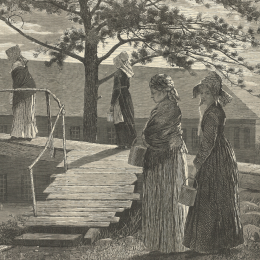
Winslow Homer Wood Engravings
The Shirley W. Brand Collection
March 2, 2024 through May 12, 2024
The Arkell Museum was recently gifted a transformative collection of Winslow Homer wood engravings. Winslow Homer Wood Engravings: The Shirley W. Brand Collection is the first time a selection of these extraordinary wood engravings will be on view here at the Arkell Museum. We are so grateful to the family of Shirley W. Brand for this incredible gift.
Winslow Homer began his career as an art illustrator in the late 1850s, creating images for popular publications including Ballou’s Pictorial and Harper’s Weekly. He served as a wartime correspondent for Harper’s Weekly, capturing important battle, camp, and community scenes during the Civil War. Homer also excelled at depicting scenes from everyday life: farm fields, city streets, windy beach bluffs, factory workers, fishing parties.
This exhibition features some of Homer’s most famous and recognizable images such as The Dinner Horn and The Noon Recess as well as images that may be lesser known but are equally stunning and engaging. Image themes presented in this first sampling include Agriculture, Work, Entertainment, the Civil War, and Social Commentary.
This exhibition is made possible by the New York State Council on the Arts with the support of the Office of the Governor and the New York State Legislature.
Winslow Homer (1836-1910)
The Morning Bell
Wood engraving on paper
Harper’s Weekly; December 13, 1873
Arkell Museum Collection
Gift of the family of Shirley W. Brand, 2020
You told me earlier in the year that some day you wanted a fine Inness…
Robert Macbeth to Bartlett Arkell, March 8, 1917
The Macbeth Gallery had a profound impact on the development of American art. It was the first gallery in New York City to focus on work by American artists, and held many ground-breaking exhibits. Today, the gallery is recognized for raising an interest in and creating a market for American art during its sixty-plus years as an influential firm (1892-1953). Our founder Bartlett Arkell made many important purchases at the Macbeth Gallery, and worked closely with gallery directors to build our extraordinary collection. This exhibit is a tribute to his vision for the future, and the early work of the Macbeth Gallery.
Extended into 2024, this popular exhibition features six Winslow Homer watercolors, two George Stuart portraits, and oil paintings of the Erie Canal. Also included in the exhibition are works by John Singer Sargent, George Bellows, Jon Corbino, Paul Sample, George Luks, and many more.
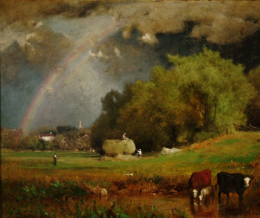
George Inness (1825-1894)
The Rainbow, ca. 1878
Oil on canvas
Arkell Museum Collection, Gift of Bartlett Arkell
Purchased by Bartlett Arkell from the Macbeth Gallery, 1934
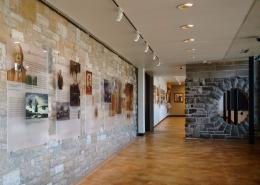
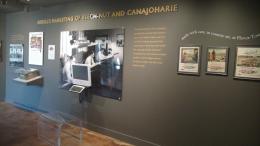
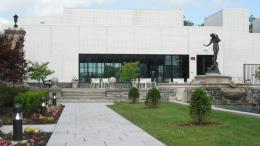
Learn about the early history of the Beech-Nut Packing Company and their use of fine art in advertising. Learn more about the Arkell Family: their philanthropy, business interests, and more. Don't miss the full color garden party video filmed at the Arkell home! Step outside and enjoy the beauty of the Memorial Garden, designed by Bartlett Arkell and built in memory of his wife Louisanna Grigsby Arkell.
This gallery features late 19th and early 20th-century American paintings purchased by Bartlett Arkell, our founder and first president of the Beech-Nut Packing Company, specifically to share with his community. Works on display include all seven of our oil paintings by Winslow Homer (reunited after independent loans to Germany, Maine, and Massachusetts), and significant paintings by many distinguished American artists including William M. Chase, Childe Hassam, George Inness, and Albert Bierstadt. The inspiration of Bartlett Arkell, this original art gallery opened to the public in 1929, and was once accessed from the original stand-alone Library building through two doors. Today, these doors are windows providing Library patrons a glimpse into the gallery and Museum visitors a glimpse into the original Library (now our Reading Room). Also not to be missed in this gallery is the full scale copy of The Night Watch by Rembrandt, commissioned by Arkell specifically for this space, and on display today.
